My previous post introduced the poem I've been drafting, Deep-Step and Twice-Mortal. Most of Deep-Step uses five-beat rising lines in terza rima stanzas.
Terza rima stanzas progress in an interlocked rhyme pattern: they are tercets rhyming aba bcb cdc ded, et cetera et cetera.
Dante invented terza rima for his Comedy, which remains the form's most famous example. That fact's one reason I chose terza rima: though the style and tone of Deep-Step vary from those of the Comedy, it too follows a journey into the underworld, a katabasis---or deepwending, as I calqued the word for Cosmic Warlord Kin-Bright.
Terza rima presents challenges.
First, each rhyme sound must occur three times. A point of comparison: my previous venture into the underworld, in Kin-Bright IX–X, used rhyme royal stanzas, ababbcc. Rhyme royal only requires a third of the rhyme sounds---each stanza's b-rhyme---to occur thrice. The a- and c-rhymes only require as much thought as they'd need in couplets. In terza rima, by contrast, every rhyme-sound makes a three-instance commitment.
Second, terza rima requires more long-range prediction. The form produces a cascade of interlaced rhymes, avoiding adjacent rhymes. If you write terza rima in a strictly linear fashion, you choose in each stanza's second line what sound will end the first and last lines of the next stanza. At that moment, in the middle of stanza A, you might have only a vague idea of what you plan to say in stanza B! To put it another way, in linear terza rima composition you are forever writing big cheques and only later finding out if you have enough rhymes in the bank to cash 'em.
Consequently, terza rima tends to reduce the linearity of composition. I found myself shuttling vertically up and down my drafts, holding each stanza in abeyance until its successor had at least partially emerged.
Was it like this for Dante? Probably, at least a bit. Dante was a far better poet than I am, mind. And he wrote at greater length in terza rima. And he lived in an era that cultivated memory arts far more strongly than we do. For all those reasons, he was probably more used to holding multiple stanzas in his head!
Plus, rhyme is easier in Italian than in English. Some remarks on English rhyme follow in my next post.
P.S. In the unlikely event that you're a Dante sicko and you also like Vampire Survivors, go have a look at Hell Maiden and its demo. The mechanics borrow from familiar influences, but I like its aesthetic, and it has some quite niche Dantean jokes in it.
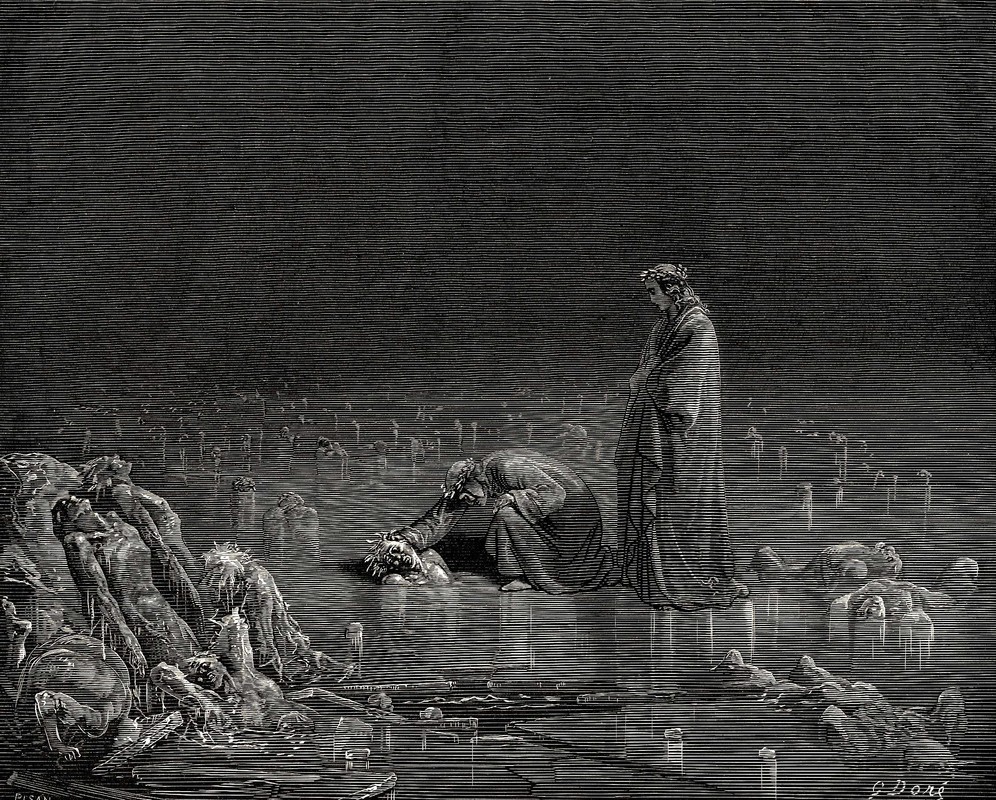
Image: Dante and Virgil in the Ninth Circle of Hell. Dante confers with traitors frozen in ice. Gustave Doré. Public domain. Sourced from Wikimedia Commons.